In just four days, a former head of state was sentenced to 24 years in prison, and another was arrested. Is South Korea a corrupt country or a mature democracy?
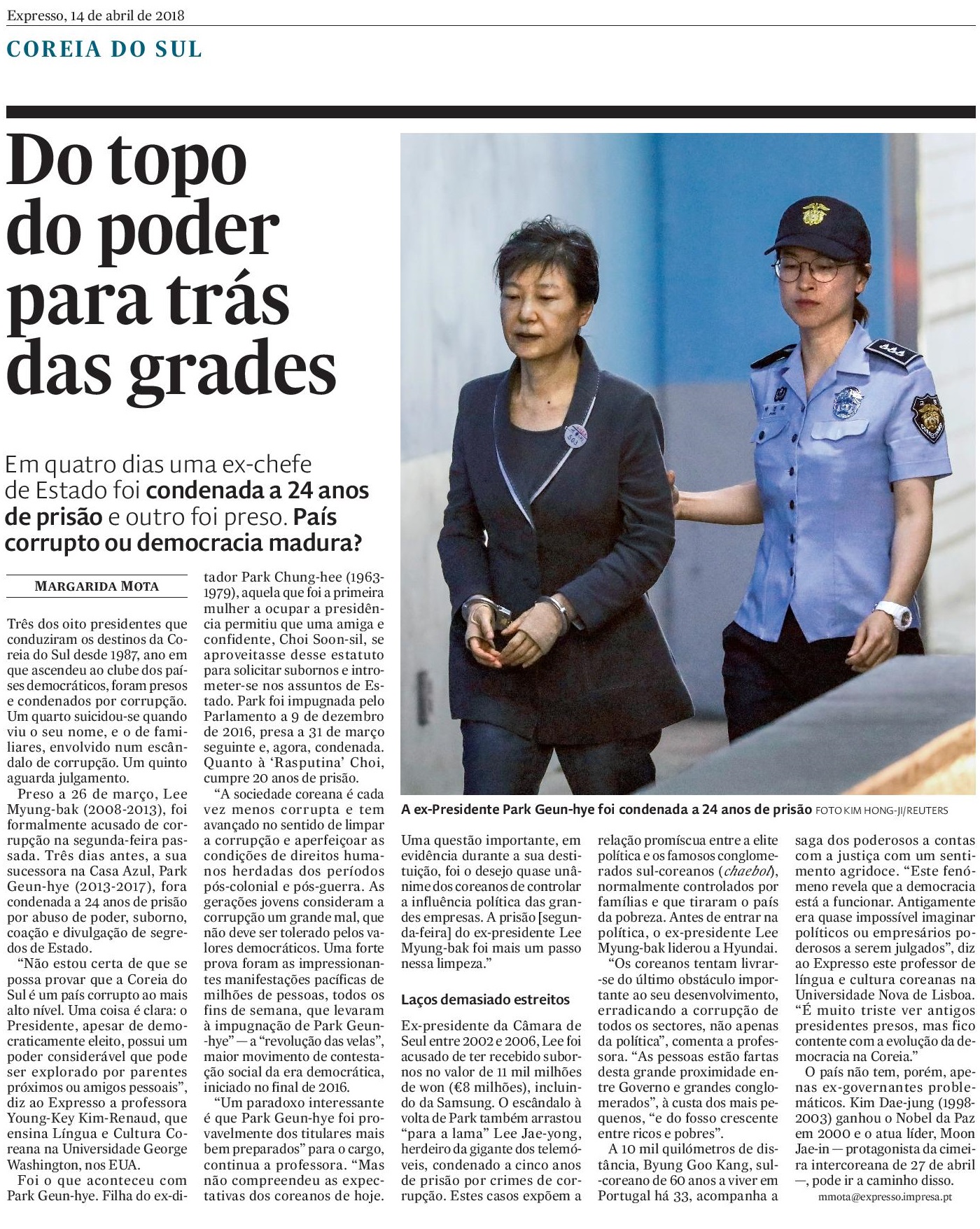
Since 1987, the year South Korea joined the club of democratic countries three out of eight presidents were arrested or convicted of corruption. A fourth committed suicide after being implicated together with his relatives in a corruption scandal. A fifth is awaiting trial. Lee Myung-bak (2008-2013), who had been arrested on March 26, was formally indicted for corruption last Monday. Three days earlier, her successor at the Blue House, Park Geun-Hye (2013-2017), had been sentenced to 24 years in prison, charged with abuse of power, bribery, coercion, and leaking government secrets.
“I am not sure if it can be proved that South Korea is a corrupt country at the highest level. One thing is nevertheless clear. The President, although democratically elected, has a considerable power that can be manipulated by close relatives or personal friends”, said Young-Key, professor of Korean Language and Culture at George Washington University, in the USA, to the newspaper Expresso.
This is what happened to Park Geun-hye. Daughter of the former dictator Park Chung-hee (1963-1979), the first woman to hold the presidency allowed her friend and confidante Choi Soon-sil to take advantage of her status, to ask for bribes, and to interfere in the affairs of the state. Park was impeached by the Parliament on December 9, 2016 and detained on March 31, and has now been imprisoned. As for “Rasputinesque Choi”, she is serving 20 years in prison.
“Korean society is less and less corrupt, and has been moving towards eliminating corruption and improving the human rights conditions inherited from the post-colonial and the post-war periods. For the younger generations, corruption is a great evil that should not be tolerated by democratic values. That was strongly confirmed by peaceful demonstrations by millions of people every weekend leading to the resignation of Park Geun-Hye – the so-called “candle revolution”, the biggest social protest movement in the country’s democratic era, which began at the end of 2016.
“An interesting paradox is that Park Geun-hye was probably one of the best skilled leaders” for her position, added the professor in Washington. “But she didn’t understand the South Korean expectations. During her impeachment process, it was significant how Koreans almost unanimously wished to limit the political influence of big corporations. The arrest [on Monday] of former President Myung-bak was another step in the direction of this cleanup.”
Too close links
Former mayor of Seoul between 2002 and 2006, Lee was accused of receiving bribes worth 11 billion won (€8 million), including from Samsung. The scandal involving Park also “dragged through the mud” Lee Jae-yong, the heir of the electronics giant, sentenced to five years in prison for corruption crimes. These cases expose the promiscuous relations between the political elite and the famous South Korean conglomerates (chaebol), usually controlled by families that rescued the country out of poverty. Before going into politics, former President Lee Myung-bak was the CEO of Hyundai.
“Koreans are trying to get rid of the last major obstacle to their development, eradicating corruption in all sectors, and not only in politics”, says the professor in Washington. “People are fed up with this close proximity between the Government and the big economic groups” at the expense of the smaller ones, “and of the growing gap between rich and poor.”
Ten thousand kilometers away from his home country, 60-year old South Korean Byung Goo Kang, who has been living in Portugal for the last 33 years, is following the saga of the powerful forced to be accountable to justice with a bittersweet feeling. “This phenomenon demonstrates that democracy is working. In the past, it was almost impossible to imagine powerful politicians and businessmen being tried in a court of law”, the professor of Korean Language and Culture at the Universidade Nova de Lisboa [New University of Lisbon] said to Expresso. “It is very sad to see former presidents arrested, but I am happy with the progress of democracy in Korea.”
Not all former rulers are problematic, though. Kim Dae-jung (1998-2003) was awarded the Nobel Peace Prize in 2000, and the current President, Moon Jae-in – one of the protagonists of an inter-Korean summit to be held on April 27 – may follow suit.
(Foto: Casa Azul, residência do Presidente sul-coreano, em Seul FOTO WIKIMEDIA COMMONS)
Artigo publicado no “Expresso”, a 14 de abril de 2018. Tradução de Margarida Santos Lopes, a quem agradeço o profissionalismo e a amizade! O original, em português, pode ser lido aqui